Stage 0 Rate Noise Self-Check
Testing a realistic UTR in the Stage 0 pipeline to verify that we can recover
the injected rate to within the typical uncertainty of the reported
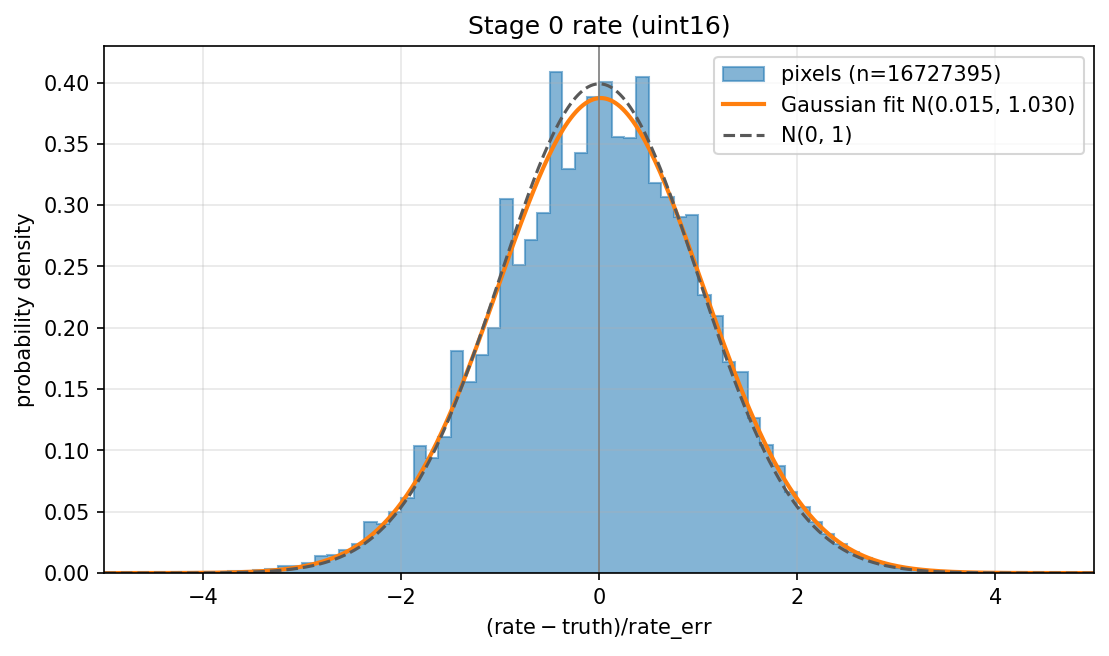
rate_err. This example displays (rate − truth) / rate_err with a
Gaussian fit overlay. The test is performed twice, using an ideal float32
UTR and again with a realistic uint16 UTR.
The HISPEC DRP is in active development. Please submit issues and suggestions on the GitHub.
Warning
Setup. Set these in your shell / notebook kernel before running (or let
the first cell create a local cache under OUT):
Variable |
Required when |
Purpose |
|---|---|---|
|
Always |
Local KOA calibration cache directory (and SQLite DB) |
|
Optional remote sync |
Keck Observer account email |
|
Optional remote sync |
Keck Observer account password |
Imports and output directory
import os
import hispecdrp

OUT = "/path/to/stage0_rate_noise_selfcheck"
os.makedirs(OUT, exist_ok=True)
os.environ.setdefault(
    "KOA_CALIBRATION_CACHE",
    os.path.join(OUT, "cals", "KOA_CALIBRATION_CACHE"),
)
print(f"OUT={OUT}")
1. KOA caldb
Calibrations are downloaded for this step as the simulator
create_ramp_from_spectrum below can use realistic calibrations stored on
KOA.
from hispecdrp.calibrations import verify_koa_calibrations

SPECTROGRAPH = "BSPEC"
summary = verify_koa_calibrations(
    SPECTROGRAPH, ignore_missing_cal_types=["lfc_wavesol"]
)
print(f"{summary['spectrograph']}: {summary['n_records']} records")
2. Simulate float32 / uint16 UTRs
import numpy as np
from hispecdrp import datamodels
from hispecdrp.simulations.simulate_up_the_ramp import create_ramp_from_spectrum

FIBERS = [2]
N_READS = 10
SEED = 0

ramp_float32, cals, rate_map = create_ramp_from_spectrum(
    OUT,
    spectrograph=SPECTROGRAPH,
    fibers=FIBERS,
    template_filename="lte049.0-2.5-0.0a+0.0.BT-Settl.spec.7.h5",
    mag_ab=3.05,
    filter_band="J",
    n_reads=N_READS,
    seed=SEED,
    poisson_noise=True,
    convert_to_uint16=False,
    clip_ramps=True,
    use_master_calibrations=True,
    ramp_filename="simulated_ramp_float32.fits",
    overwrite_ramp=True,
)

u16 = np.clip(np.round(ramp_float32.data), 0, np.iinfo(np.uint16).max).astype(np.uint16)
meta_u16 = dict(ramp_float32.meta)
meta_u16["filename"] = "simulated_ramp_uint16.fits"
ramp_uint16 = datamodels.RampModel(
    data=u16,
    dq_raw=np.asarray(ramp_float32.dq_raw).copy(),
    meta=meta_u16,
)
ramp_uint16.save(filepath=os.path.join(OUT, ramp_uint16.meta.filename))
ramps = {"float32": ramp_float32, "uint16": ramp_uint16}
print(f"Stage-0 cals: {sorted(cals)}")
print(f"nonlin note: {getattr(getattr(cals.get('nonlin'), 'meta', None), 'note', None)}")
3. Stage 0
This cell will call the Stage0Pipeline for the uint16 and float32 UTR
frames with: Stage0Pipeline.call(ramp, output_dir=OUT) using all default
pipeline arguments. Products will be stored under OUT.
from hispecdrp.pipelines import Stage0Pipeline

l0s = {
    label: Stage0Pipeline.call(ramp, output_dir=OUT)
    for label, ramp in ramps.items()
}
4. Histograms of recovered versus injected rate levels
(rate − truth) / rate_err with a Gaussian fit demonstrating that the
pipeline can recover a rate map resembling the injected value. After subtracting
the injected value and normalizing by the recovered error map, we should see a
normal distribution of pixels with a mean of 0 and unit variance.
from hispecdrp.simulations.plotting import plot_stage0_rate_pull_histogram

for label, l0 in l0s.items():
    plot_stage0_rate_pull_histogram(
        l0.rate,
        l0.rate_err,
        rate_map,
        dq=l0.dq,
        error_mode="fit",
        title=f"Stage 0 rate ({label})",
        print_stats=False,
    )
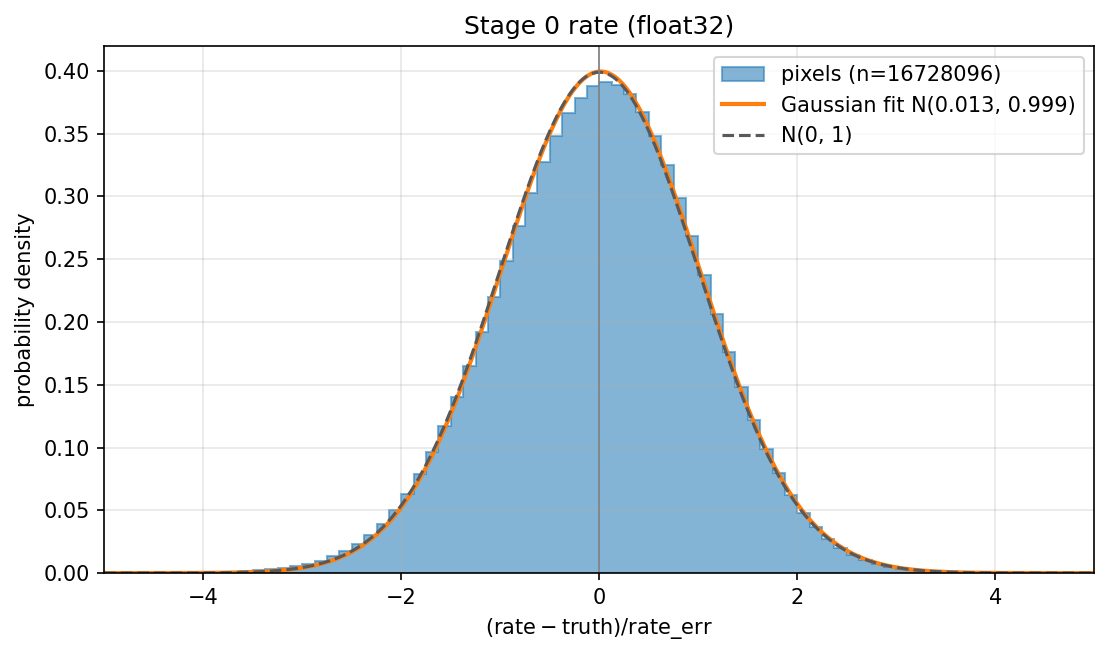
Histograms of recovered versus injected rate levels for the ideal
float32 UTR ((rate − truth) / rate_err with Gaussian fit).